Description
Back to topReinforcement learning (RL) is widely regarded as a promising frontier in artificial intelligence and a significant advancement in machine learning. This view is supported by the highly publicized successes of deep reinforcement learning in domains such as video games and classical strategy games like chess and Go. However, many of these successes rely on heuristic-based algorithmic implementations. While these heuristics often perform remarkably well, their effectiveness and underlying mechanisms remain only partially understood, even by their developers. Moreover, the majority of current RL applications focus on robotic systems, including self-driving cars, and primarily address single-agent control problems. Recently, there has been growing interest in multi-agent reinforcement learning, which involves coordinating systems such as fleets of autonomous vehicles, presenting heightened mathematical and computational challenges. These challenges become even more pronounced in systems involving a large number of agents, where direct modeling and control are computationally prohibitive. In such cases, mean-field approximations have emerged as a powerful tool to scale reinforcement learning algorithms by approximating the interactions among agents through aggregate effects. This workshop will focus on multi-agent RL and mean-field RL. Besides the talks, we will organize one or two tutorials on Markov Decision Processes and Mean Field Games to help students be more familiar with the topic of the workshop. We will also organize a special lecture and a session of lightning talks for the long program attendees.
Lightning Talks
This workshop will include lightning talks for early career researchers (including graduate students). In order to propose a lightning talk, you must first register for the workshop, and then submit a proposal using the form that will become available on this page after you register. The registration form should not be used to propose a lightning talk.
The deadline for proposing is Sunday, March 22, 2026. If your proposal is accepted, you should plan to attend the event in-person.
In-Person Registration
Seats are limited at the venue, which means that in-person registration may be capped prior to the workshop start date. If capacity is reached, a waitlist will be imposed, which the registration form will reflect. Early registration is strongly encouraged.
All in-person registrants must wait to receive an invitation to attend in-person from IMSI before traveling, which generally begin to be sent out 4-6 weeks in advance.
All registrants (online and in-person) will receive zoom links and are welcome to attend online.
Organizers
Back to topSpeakers
Back to topSchedule
Speaker: Jean-Pierre Fouque (University of California, Santa Barbara (UCSB))
Speaker: Xunyu Zhou (Columbia University)
Speaker: Michael Wellman (University of Michigan)
Speaker: Eugene Vinitsky (New York University)
Speaker: Sebastian Jaimungal (University of Toronto)
Speaker: Pascal Poupart (University of Waterloo)
Speaker: Na Li (Harvard University)
Speaker: Sébastien Bubeck (OpenAI)
Speaker: Tamer Basar (University of Illinois Urbana-Champaign (UIUC))
Speaker: Erhan Bayraktar (University of Michigan)
Speaker: Giorgia Ramponi (University of Zurich)
Speaker: Gökçe Dayanıklı (University of Illinois Urbana-Champaign (UIUC))
Speaker: Rama Cont (University of Oxford)
Speaker: Kaiqing Zhang (University of Maryland)
Speaker: Aditya Mahajan (McGill University)
Speaker: Thaleia Zariphopoulou (University of Texas at Austin)
Speaker: Yuhua Zhu (University of California, Los Angeles (UCLA))
Speaker: Andrea Angiuli (Amazon)
Videos
Multi-scale Reinforcement Learning Algorithms for Mean Field Control Games
Jean-Pierre Fouque
May 18, 2026
ART for Diffusion Sampling: A Reinforcement Learning Approach to Timestep Schedule
Xunyu Zhou
May 18, 2026
Game Model Learning for Empirical Game-Theoretic Analysis
Michael Wellman
May 18, 2026
Reevaluating Policy Gradient Methods for Imperfect-Information Games
Eugene Vinitsky
May 18, 2026
Lightning Talks
Lightning Talks (1)
May 18, 2026
Reinforcement Learning for Quantal Mean-Field Leader-Follower Games
Sebastian Jaimungal
May 19, 2026
Lightning Talks
Lightning Talks (2)
May 19, 2026
Extending Mean Field RL to Partially Observable Environments, Agents of Multiple Types and Decentralized Learning
Pascal Poupart
May 19, 2026
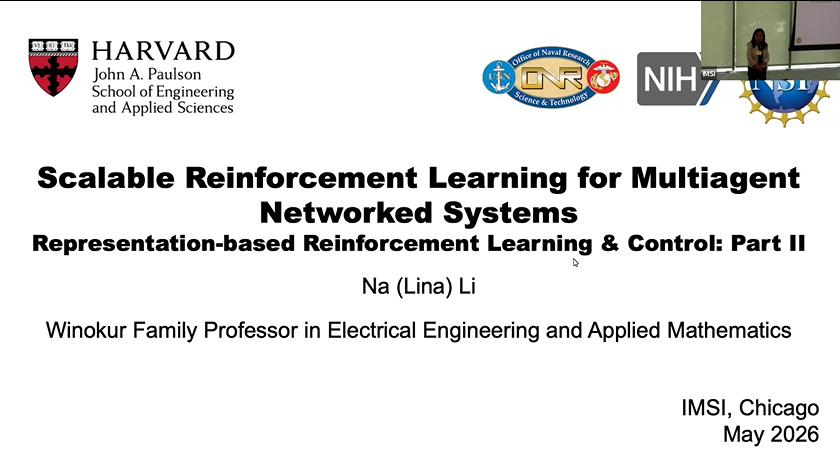
Scalable Reinforcement Learning for Networked Multi-Agent Systems
Na Li
May 19, 2026
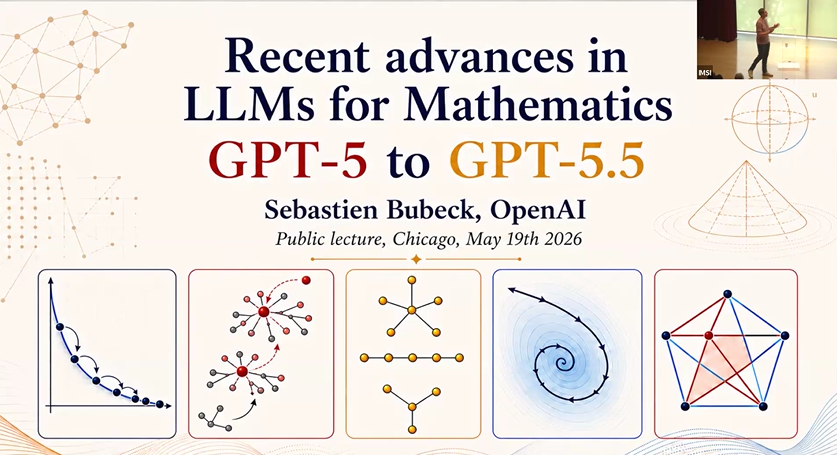
Public Lecture: Recent Advances in LLMs for Mathematics
Sébastien Bubeck
May 19, 2026
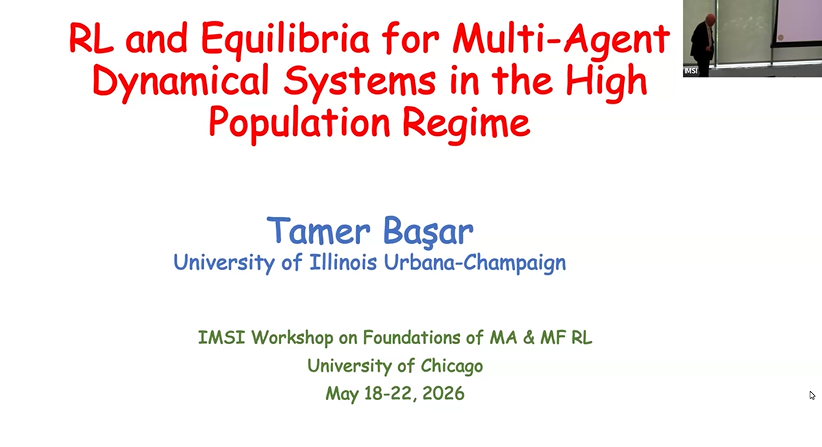
RL and Equilibria for Multi-Agent Dynamical Systems in the High-Population Regime
Tamer Basar
May 20, 2026
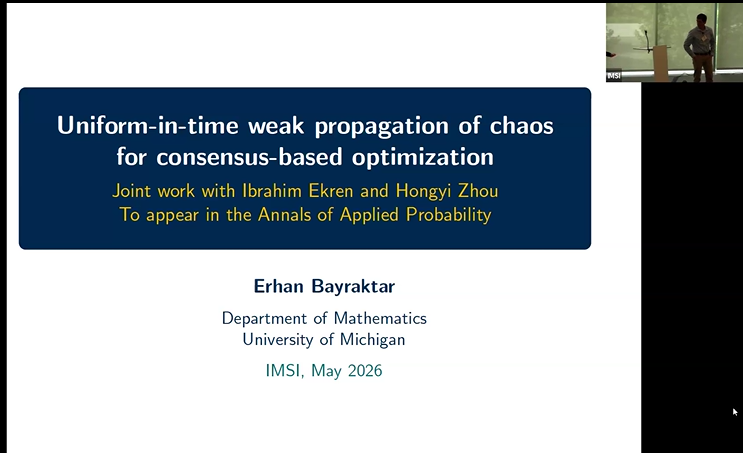
Uniform-in-time weak propagation of chaos for consensus-based optimization
Erhan Bayraktar
May 20, 2026
Imitation Learning in Multi-Agent systems
Giorgia Ramponi
May 20, 2026
Cooperation, Competition, and Common Pool Resources in Mean Field Games and Extensions with Inverse Learning
Gökçe Dayanıklı
May 20, 2026
Homogenization and mean-field approximations for systems of heterogeneous agents
Rama Cont
May 20, 2026
Towards Understanding Learning-to-Communicate in Multi-agent RL: An Information-Structure Perspective
Kaiqing Zhang
May 21, 2026
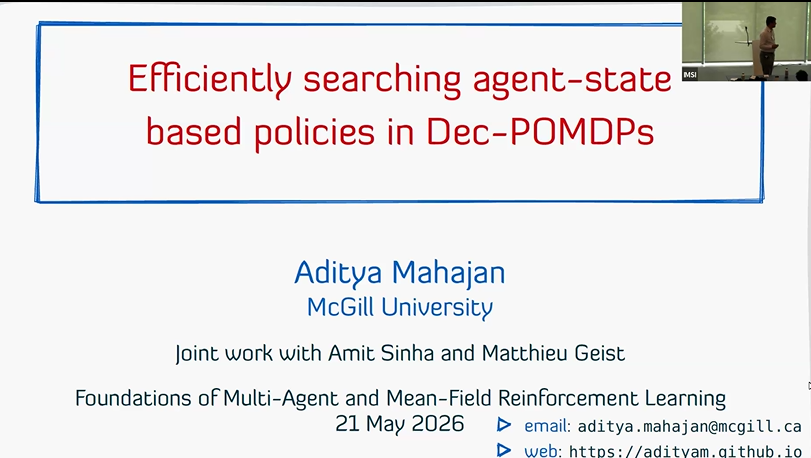
Efficiently searching for good agent state based policies in Dec-POMDPs
Aditya Mahajan
May 21, 2026
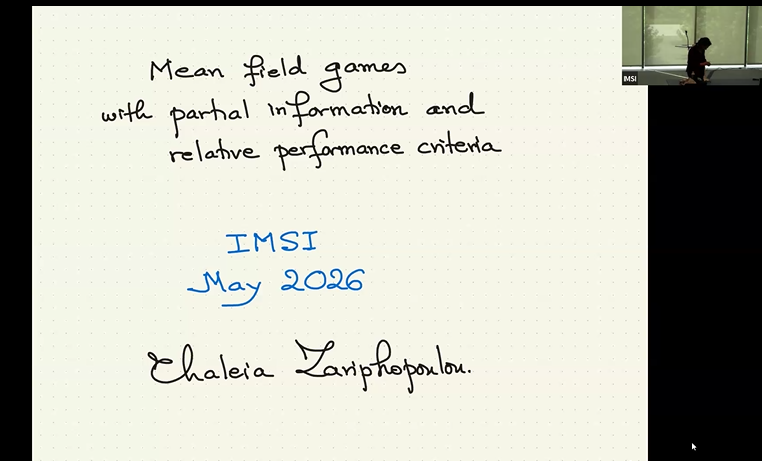
Mean field games with partial information and relative performance criteria
Thaleia Zariphopoulou
May 21, 2026
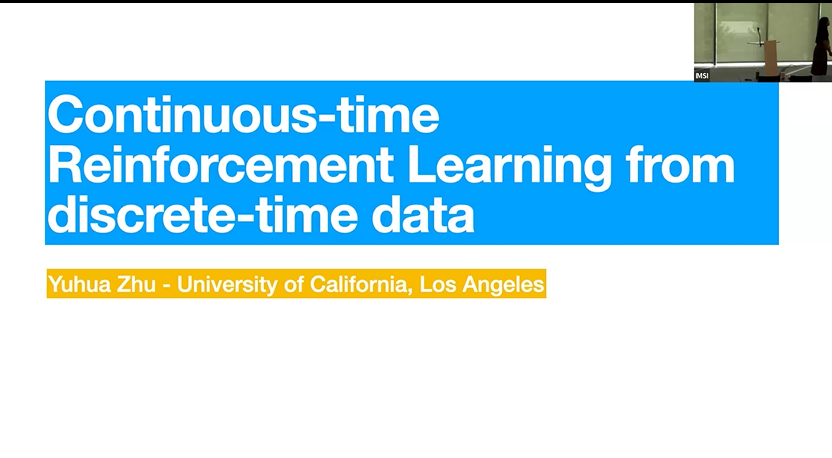
Policy Gradient for Continuous-Time Mean-Field Control from Discrete-Time Data
Yuhua Zhu
May 21, 2026
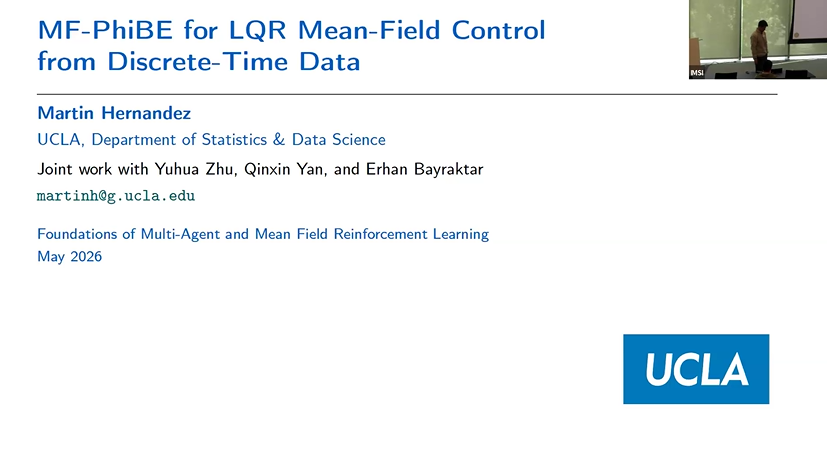
Lightning Talks
Lightning Talks (3)
May 21, 2026
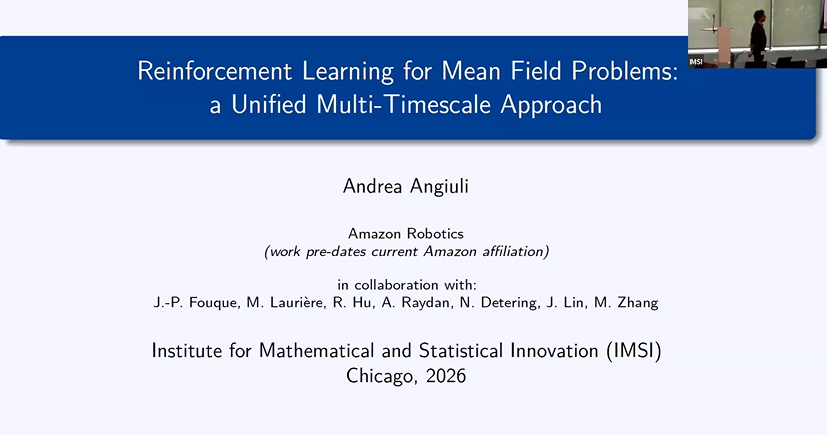
Multi-Scale Reinforcement Learning for Mean-Field Control and Game Problems
Andrea Angiuli
May 22, 2026