A new area of exploration has emerged at the crossroads of probability, geometry, and analysis, aiming to develop a unified theory of the geometry of random structures. The core question is: how does randomness interact with geometry within a given structure? Specifically, does the geometry appear to be random at every scale (i.e. fractal), or do fluctuations “average out” at sufficiently large scales? Can we describe the overall geometry through a suitable scaling limit that permits concrete calculations?
Significant advances have been achieved in this field over the past two decades, yet many fundamental problems remain and the area is developing rapidly. The objective of the workshop is to bring together specialists from probability, mathematical physics, analysis, and related disciplines to examine this issue in key scenarios. The workshop will concentrate on random objects defined either by fundamental probability models or motivated by physics. Key topics of interest include random walks (and many related models), percolation, the Gaussian free field, Schramm-Loewner evolution (SLE), random planar maps, and Liouville quantum gravity, particularly in relation to conformally invariant scaling limits.
Poster Session
This workshop will include a poster session for early career researchers (including graduate students). In order to propose a poster, you must first register for the workshop, and then submit a proposal using the form that will become available on this page after you register. The registration form should not be used to propose a poster.
The deadline for proposing is May 10, 2026. If your proposal is accepted, you should plan to attend the event in-person.
In-Person Registration
Seats are limited at the venue, which means that in-person registration may be capped prior to the workshop start date. If capacity is reached, a waitlist will be imposed, which the registration form will reflect. Early registration is strongly encouraged.
All in-person registrants must wait to receive an invitation to attend in-person from IMSI before traveling, which generally begin to be sent out 4-6 weeks in advance.
All registrants (online and in-person) will receive zoom links and are welcome to attend online.
Eveliina Peltola
Aalto University and University of Bonn
W
Q
Wei Qian
City University of Hong Kong
S
R
Steffen Rohde
University of Washington
S
S
Scott Sheffield
MIT / IAS Princeton
D
S
Daisuke Shiraishi
Kyoto University
X
S
Xin Sun
Peking University
J
S
Jinwoo Sung
University of Washington
Y
W
Yilin Wang
IHES/ETH
W
W
Wendelin Werner
University of Cambridge
X
W
Xuan Wu
University of Illinois at Urbana-Champaign (UIUC)
P
Y
Pu Yu
NYU Courant
D
Z
Dapeng Zhan
Michigan State University
Schedule
Monday, July 6, 2026
8:30-9:05 CDT
Breakfast/Opening Remarks
9:05-9:50 CDT
About loop-soups
Speaker: Wendelin Werner (University of Cambridge)
9:50-10:10 CDT
Break
10:10-10:55 CDT
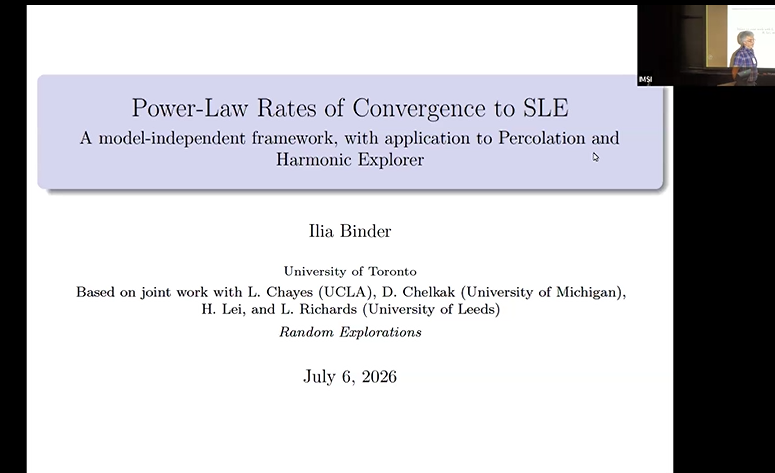
Rates of Convergence to SLE for Critical Lattice Models.
Speaker: Ilia Binder (University of Toronto)
The convergence of critical lattice interfaces to Schramm–Loewner Evolution is a central topic in two‑dimensional probability, with foundational contributions by Greg Lawler. In this talk, I will discuss recent progress on quantitative versions of this convergence, focusing on polynomial rates at which discrete interfaces approach their SLE limits. I will present a general framework that yields power‑law convergence rates under natural regularity assumptions, providing a unified approach that applies to a wide class of lattice models. As a main example, I will consider the exploration process in critical percolation and show that, for any suitably well‑behaved critical percolation model, convergence to SLE holds together with an automatic polynomial rate. In particular, this result applies unconditionally to critical site percolation on the hexagonal lattice and to several of its generalizations. I will also briefly explain how the same framework extends to other models, including the Harmonic Explorer and the critical Ising model. This talk is based on joint work with L. Chayes, D. Chelkak, H. Lei, and L. Richards.
10:55-11:35 CDT
Coffee Break
11:35-12:20 CDT
Trivariate Hypergeometric Series Formulas for Pure Partition Functions of Multiple 3-SLE_k
Speaker: Dapeng Zhan (Michigan State University)
Pure partition functions for multiple SLE are characterized by BPZ-type PDEs, M"obius covariance, and link-pattern asymptotics. In this talk I will discuss the first genuinely multivariable case, namely multiple $3$-SLE$_kappa$. After a M"obius-normalized change of variables, the problem reduces to trivariate power series in three unoriented cross-ratio variables. There are two basic topological types, the rainbow and neighbor patterns. I will explain how the reduced PDE system leads to coefficient recursions, how hidden symmetry is propagated through the coefficient lattice, and how the two-dimensional boundary degenerations are described by Appell $F_1$ and Horn $G_2$ functions. The rainbow case can be handled by direct coefficient estimates, while the neighbor case requires several Pfaff systems for analytic continuation and boundary control. Finally, I will describe how SLE martingales and It^o calculus enter the proof of positivity, and discuss the algebraic structure that appears at integer values of $beta=4/kappa$, including a conjectural formula in the neighbor case.
12:25-13:35 CDT
Lunch Break
13:35-14:20 CDT
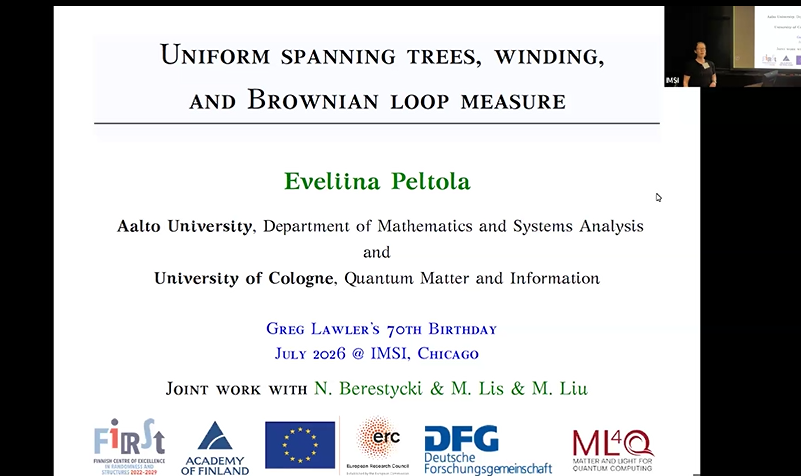
Uniform spanning trees, winding, and Brownian loop measure
Speaker: Eveliina Peltola (Aalto University and University of Bonn)
We consider a uniform spanning tree under an n-arm event. The total winding of the branches has an exact asymptotic formula, which involves the Brownian loop measure and -- interestingly -- depends on the total number of branches only through its parity. Not surprisingly, the branches converge to multiradial SLE(2), and the law of the hitting points of the branches to the boundary coincides with that of eigenvalues of an COE random matrix.
Joint work with Nathanael Berestycki, Marcin Lis, and Mingchang Liu.
14:20-15:15 CDT
Break
15:15-16:00 CDT
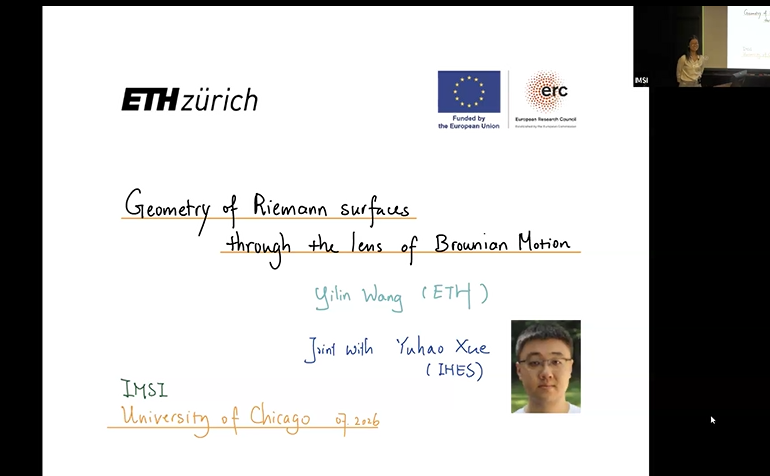
Geometry of Riemann surfaces through the lens of probability
Speaker: Yilin Wang (IHES/ETH)
We use the Brownian motion to express the harmonic measure, lengths of closed geodesics, length of orthogeodesics, zeta-regularized determinant of the Laplace-Beltrami operator of a hyperbolic surface. In particular, the lengths of closed geodesics are expressed using Brownian loop measure introduced by Lawler and Werner.
This gives a tool to study the length spectra of a hyperbolic surface and we obtain a new identity between the length spectrum of a hyperbolic surface and that of the same surface with an arbitrary number of additional cusps. This is mainly based on a joint work with Yuhao Xue (IHES).
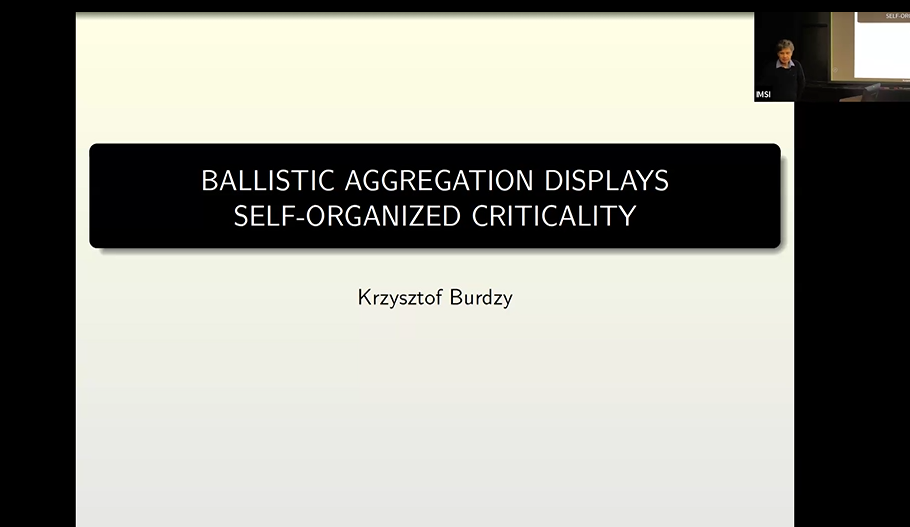
The following model was proposed by Stefan Steinerberger.Consider the convex hull of a collection of disjoint open discs withidentical radii. The boundary of the convex hull consists of a finitenumber of line segments and arcs. Randomly (uniformly) choose a pointin one of the arcs in the boundary. Attach a new disc at the chosenpoint so that it is outside of the convex hull and tangential to itsboundary. Replace the original convex hull with the convex hull of allpreexisting discs and the new disc. Continue in the same manner.
Simulations show that disc clusters form long, straight, or slightlycurved filaments with many small side branches and occasionalmacroscopic side branches. For a large number of discs, the shape ofthe convex hull is either an equilateral triangle or a quadrangle.Side branches play the role analogous to avalanches in sandpilemodels, one of the best-known examples of self-organized criticality(SOC). Simulation and theoretical results indicate that the size of abranch obeys a power law, as expected of avalanches in sandpile modelsand similar ``catastrophes'' in other SOC models.
9:45-10:05 CDT
Break
10:05-10:50 CDT
Thick points of 2d Brownian motion and conformally invariant fields
Speaker: Antoine Jego (Ceremade, Paris Dauphine)
A classical topic of study concerns points that have been visited exceptionally often by a 2d simple random walk or Brownian motion. I will explain how this study can lead to the definition of new conformally invariant fields, generalising random walk representations of the Gaussian free field. These fields are built out of a Brownian loop soup and are closely related to the structure of clusters.
10:50-11:35 CDT
Coffee Break
11:35-12:20 CDT
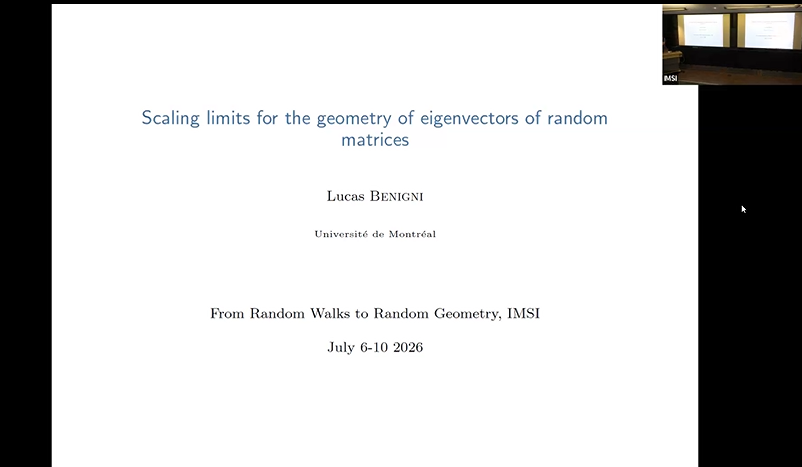
Scaling limits for the geometry of eigenvectors of random matrices
Speaker: Lucas Benigni (Université de Montréal)
The Berry random wave conjecture predicts that chaotic eigenfunctions should locally resemble Gaussian random fields. A parallel phenomenon occurs for eigenvectors of large random matrices. I will explain how bulk eigenvectors of Wigner-type matrices can be tested through deterministic observables A, leading to overlap ⟨u,Au⟩ whose fluctuations are asymptotically Gaussian. When the observable varies in a parameter t, these fluctuations converge to Gaussian processes giving a scaling-limit theory for certain eigenvector statistics.
12:25-13:35 CDT
Lunch Break
13:35-14:20 CDT
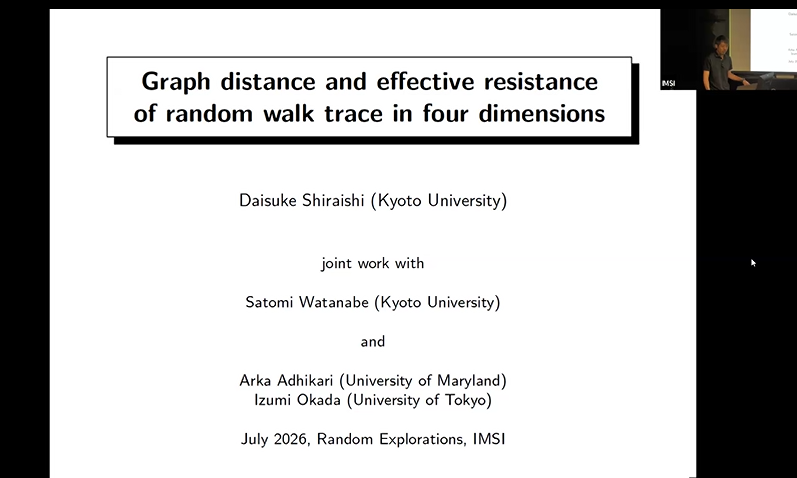
Graph distance and effective resistance of random walk trace in four dimensions
Speaker: Daisuke Shiraishi (Kyoto University)
We study geometric and electrical properties of the trace of a simple random walk in four dimensions. Viewing the random walk path as a graph, we focus on the graph distance and the effective resistance between the starting point and the current location.
Compared to related models such as loop-erased random walk, much less is known about these quantities. We present results describing their typical growth and fluctuation behavior. In particular, we identify their growth rates and show that they satisfy a weak law of large numbers but not a strong law. We also establish a non-Gaussian limiting fluctuation.
A key idea in the analysis is a connection between the graph formed by self-intersections of the random walk and a long-range percolation model.
The talk is based on two joint works: one with Satomi Watanabe, and another with Arka Adhikari and Izumi Okada.
14:20-14:40 CDT
Break
14:40-15:25 CDT
Loewner energy reversibility via local reversals
Speaker: Jinwoo Sung (University of Washington)
The Loewner energy of a chord in a simply connected planar domain is defined as the Dirichlet energy of the driving function for the corresponding Loewner chain. A fundamental property is its reversibility, which means that the energy of a chord does not depend on the direction in which it is unzipped by a Loewner chain. Yilin Wang first proved this property using the reversibility of chordal Schramm–Loewner evolution (SLE), identifying Loewner energy as the large deviation rate function for chordal SLE as κ decreases to 0. I will present a deterministic proof of this fact by reversing the chord in small increments, using the commutation relations of Loewner energy. Along the way, I will highlight similarities with and differences from the proofs of SLE reversibility by Dapeng Zhan and by Greg Lawler and Stephen Yearwood.
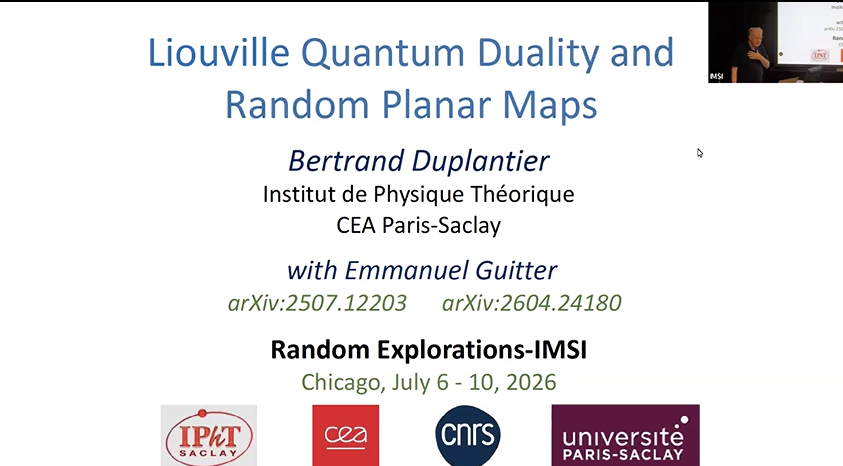
We discuss block-weighted map models in which random planar maps, possibly decorated by a statistical system, are canonically decomposed into elementary blocks, connected to each other by pinch points to form a tree structure. When a weight $u$ is assigned to each block, a phase transition occurs at a critical value, above which the maps degenerate into Brownian trees. The enumerative properties and critical exponents of maps below and at the critical value are linked by duality relations that are precisely those predicted by Liouville quantum gravity (LQG) when the dual measure is atomic. The Hausdorff dimensions of these objects also obey duality relations. At the dual critical point, we give the conditional distribution of the root block size given the total size, and conversely, the distribution of the total size for a fixed root block size, which perfectly agree with the results of LQG duality. The ratio of dual and direct partition functions with punctures is shown to be universal, its explicit LQG expression exactly matching its combinatorial analogue. The block distance profile for doubly rooted maps is shown to be rigorously related to the distance profile of maps consisting of a single block. Finally, we consider the multifractal properties of the usual and dual Liouville measures. We illustrate these results through specific realizations of block-weighted maps, quadrangulations, the original Das et al. baby-universe model, and bicubic maps. For each model, we give the single non-universal constant which uniquely determines the strength of the corresponding atomic Liouville measure.
Based on joint works with Emmanuel Guitter:
“Liouville Quantum Duality and Random Planar Maps I & II”, arXiv:2507.12203, arXiv:2604.24180.
9:45-10:05 CDT
Break
10:05-10:50 CDT
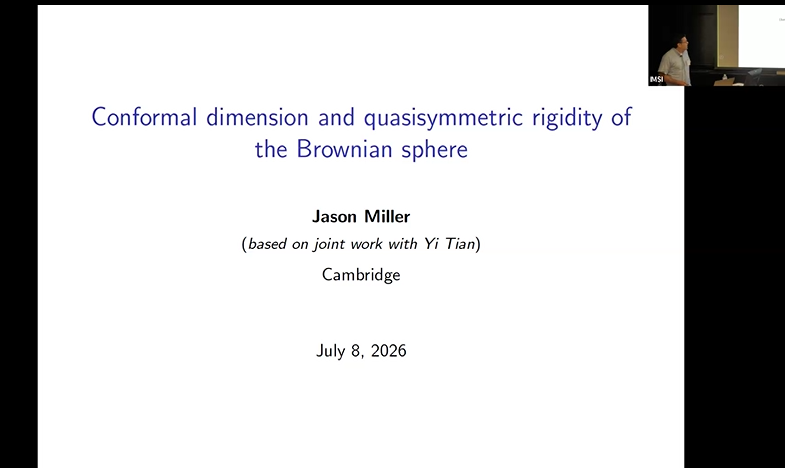
Conformal dimension and quasisymmetric rigidity of the Brownian sphere
Speaker: Jason Miller (University of Cambridge)
The conformal dimension of a metric space $(X,d)$, introduced by Pansu in 1989 in the context of Gromov-hyperbolic groups, is the infimum of the Hausdorff dimensions of all metric spaces quasisymmetrically equivalent to $(X,d)$. It is always bounded between the topological and Hausdorff dimensions of $(X,d)$. In this talk, we describe recent work showing that the conformal dimension of the Brownian sphere is exactly 2, matching its topological dimension. We also discuss a complementary result establishing that the Brownian sphere is quasisymmetrically rigid, meaning its group of quasisymmetric automorphisms is almost surely trivial. This talk is based on joint work with Yi Tian.
10:50-11:35 CDT
Coffee Break
11:35-12:20 CDT
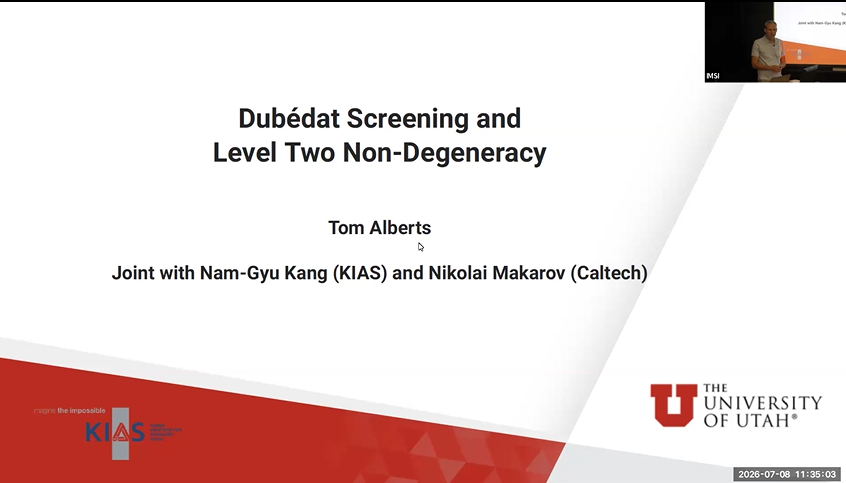
Dubedat Screening and Level Two Non-Degeneracy
Speaker: Tom Alberts (University of Utah)
Dubedat screening refers to a conformal field theoretic method for solving BPZ equations, a system of PDEs whose solutions describe multiple chordal SLE curves in a simply connected domain. This talk explains how the solution introduces a level two non-degenerate vertex exponential into the system, and how this leads to a loss of a martingale observable property for the evolution of a field under the corresponding SLE flow.
12:25-13:35 CDT
Lunch Break
13:35-14:20 CDT
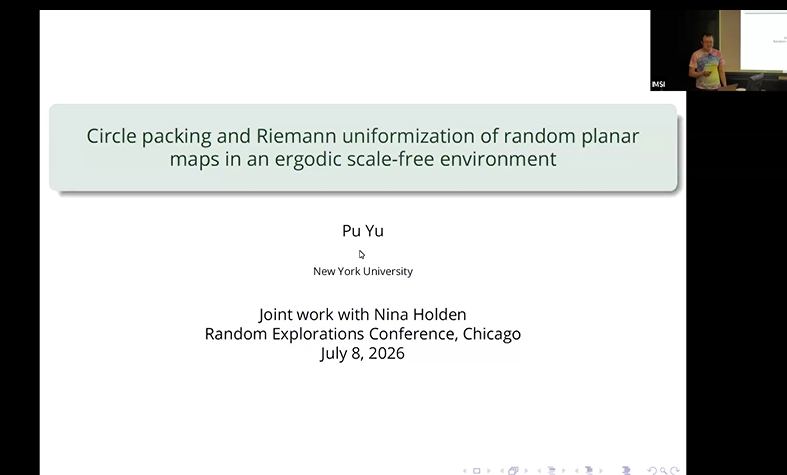
Circle packing and Riemann uniformization of random planar maps from ergodic scale-free environments
Speaker: Pu Yu (NYU Courant)
In this talk, we show that for random planar maps arising from ergodic scale-free environments, their circle packing and Riemann uniformization embedding are close to the a priori embedding on a large scale. Ergodic scale-free environments was first considered by Gwynne, Miller and Sheffield (2018), where they proved that random walks on these graphs converge to Brownian motion. This is an intermediate step towards proving the convergence of UST weighted planar maps to sqrt{2}-LQG under circle packing and Riemann uniformization embedding. Based on joint work with Nina Holden.
14:20-15:15 CDT
Coffee Break
15:15-16:00 CDT
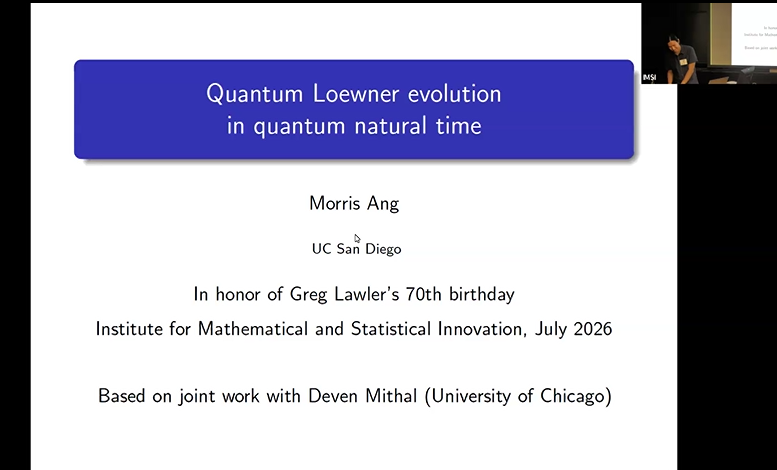
Quantum Loewner evolution in quantum natural time
Speaker: Morris Ang (University of California, San Diego)
Quantum Loewner evolution (QLE), introduced by Miller and Sheffield, is a continuum growth process on Liouville quantum gravity surfaces, proposed as the scaling limit of growth models on random planar maps (e.g., diffusion-limited aggregation on spanning-tree-weighted random planar maps). We construct a variant of QLE whose time parametrization is the continuum analog of the intrinsic time parametrization of discrete growth models. I will describe the motivation from discrete growth processes, the construction, and fundamental properties. In particular, quantum natural time QLE has three phases analogous to those of SLE, and satisfies Markov properties identifying the random surfaces cut out by the process. Based on joint work with Deven Mithal.
17:45-18:45 CDT
Cocktail Hour (The Library of Quadrangle Club)
18:45-20:15 CDT
Banquet (The Solarium of Quadrangle Club)
20:15-21:15 CDT
Dessert and Drinks Reception (The Lounge of Quadrangle Club)
Thursday, July 9, 2026
8:30-9:00 CDT
Sign-in/Breakfast
9:00-9:45 CDT
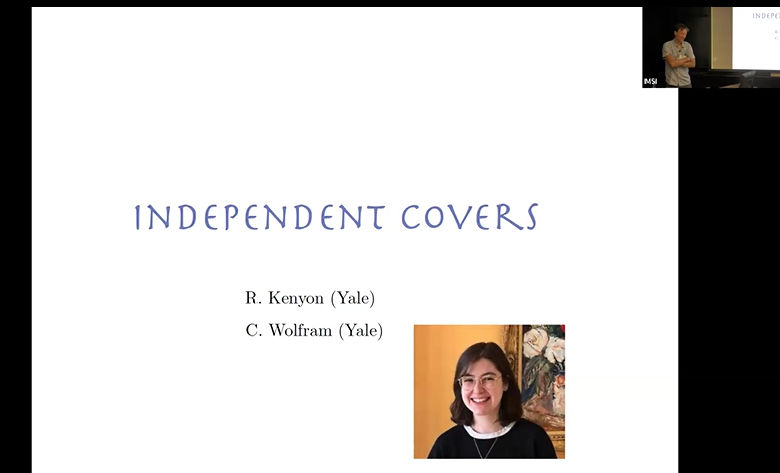
Independent Coverings
Speaker: Rick Kenyon (Yale University)
This is joint work with Catherine Wolfram. We describe a new family of determinantal probability measures in d dimensions called Independent Coverings. Given a region G in Z^d of size n, and fixed polyomino t, an independent covering of G by t is collection of n different translates of t which covers G and is independent in the sense that the incidence matrix between those translates and G is of full rank. We define a natural probability measure on the set of independent coverings, show that it is a determinantal measure, and compute some of its properties, including scaling limits and, sometimes, conformal invariance. Generalizations to multiple tiles are readily available.
9:45-10:05 CDT
Break
10:05-10:50 CDT
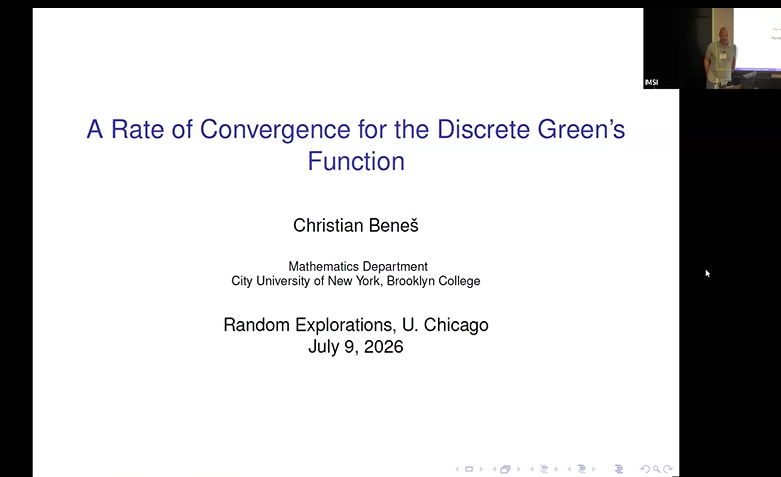
Rates of Convergence for the Random Walk Green’s Function
Speaker: Christian Benes (CUNY)
We present an upper bound for the rate of convergence of the random walk Green's function to the Brownian motion Green's function in cone-convex domains. The bound unsurprisingly depends on the regularity of the domain.
10:50-11:35 CDT
Coffee Break
11:35-12:20 CDT
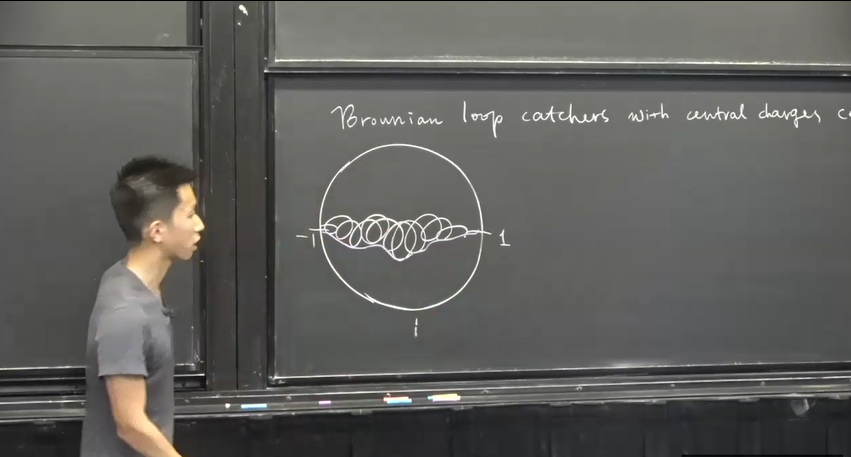
Brownian loop catchers with central charges $-2le c<0$
Speaker: Gefei Cai (Peking University)
We introduce a family of random closed subsets of Brownian traces, called Brownian loop catchers, with central charge in the range $-2le c<0$. Such a Brownian loop catcher with central charge $c$, together with the loops intersecting it from an independent Brownian loop soup of intensity $-c/2$, recovers the original Brownian trace in law. At $c=-2$, this object is the continuum loop-erased random walk, which is SLE$_2$ in two dimensions; as $cuparrow 0$, it degenerates to the Brownian trace itself. We prove that in two dimensions, the outer boundary of a Brownian loop catcher with central charge $-2le c<0$ is locally SLE$_kappa$, where $c=1-6left(frac{2}{sqrt{kappa}}-frac{sqrt{kappa}}{2}right)^2$. Consequently, a planar Brownian trace contains an SLE$_kappa$-type curve for every $kappain[2,8/3]$.
12:25-13:35 CDT
Lunch Break
13:35-14:20 CDT
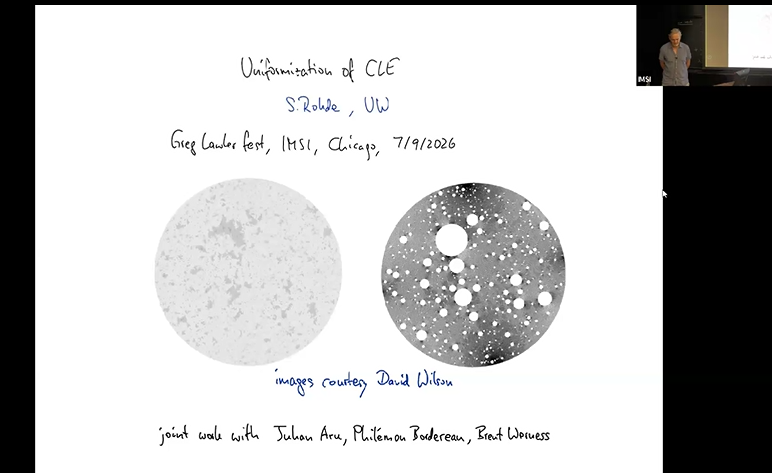
Uniformization of CLE
Speaker: Steffen Rohde (University of Washington)
We will discuss conditions on Sierpinski carpets that allow for uniformization to round carpets, with an eye towards application to the conformal loop ensemble.
14:20-15:15 CDT
Coffee Break
15:15-16:00 CDT
Loop ensembles and the Polyakov conjecture
Speaker: Scott Sheffield (MIT / IAS Princeton)
I will discuss spin models on Z^2 taking values in either a sphere or a real projective space. Understanding the scaling limits of these models (or even understanding whether one has exponential decay of correlations at low temperatures) is a major open problem. I will explain how understanding this model is in some sense equivalent to understanding a natural "random loop ensemble" model, related to loop soups. I will discuss both what is known and what remains to be understood.
Friday, July 10, 2026
8:30-9:00 CDT
Sign-in/Breakfast
9:00-9:45 CDT
Percolation Property of 2D Brownian Motion: CFT Perspective and Exact Solvability
Speaker: Xin Sun (Peking University)
It is well known that the non-intersection exponents for planar Brownian motion agree with the alternating (2N)-arm exponents for 2D percolation, both of which were originally predicted in the physics literature using conformal field theory (CFT). For 2D percolation, the CFT perspective has led to a range of exact solvability results going far beyond scaling exponents. This motivates a systematic study of planar Brownian motion from the same viewpoint.
In this talk, I will present recent progress in this direction, including several new exact formulae for Brownian partition functions in the annulus. The talk is based on joint works with Xuesong Fu, Gefei Cai and Zhuoyan Xie; with Gefei Cai, Jiaqi Liu, Wei Qian and Baojun Wu; with Guillaume Baverez, Antoine Jego and Baojun Wu; and with Gefei Cai, Baojun Wu and Zhuoyan Xie.
9:45-10:05 CDT
Break
10:05-10:50 CDT
Langevin dynamics for non-intersecting curves
Speaker: Xuan Wu (University of Illinois at Urbana-Champaign (UIUC))
In this talk I will introduce the Langevin dynamics associated with Dyson Brownian motion and Dyson Brownian bridges. The main object is a singular system of SPDEs, the multilayer reflected stochastic heat equation (RSHE). It is the canonical infinite-dimensional Langevin dynamics whose invariant measures are laws of Dyson Brownian motion and Dyson Brownian bridges. The construction is motivated by Glauber dynamics for lozenge tilings. We show that, under a suitable scaling, the stationary Glauber dynamics converge to the multilayer RSHE. This is joint work with Pei-Ken Hung and Li-Cheng Tsai.
10:50-11:35 CDT
Coffee Break
11:35-12:20 CDT
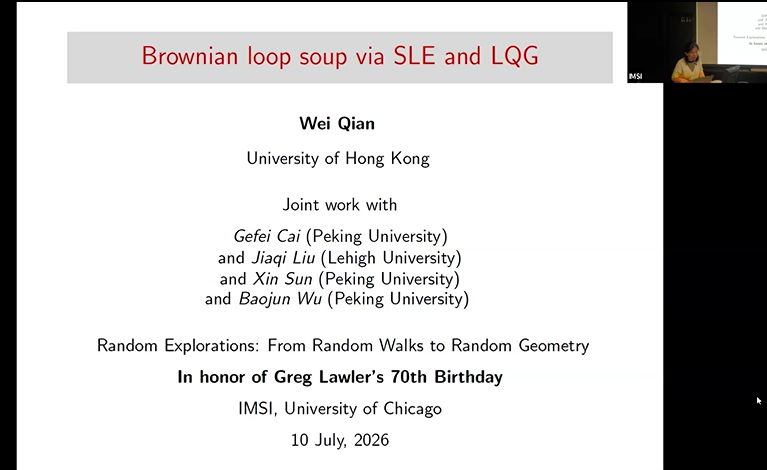
Brownian loop soup via SLE and LQG
Speaker: Wei Qian (University of Hong Kong)
Starting from a simple observation relating the Brownian loop soup and SLE loop measure, and exploiting the connections between the Brownian loop soup, Liouville quantum gravity, and Liouville conformal field theory, we derive the joint law of the outer and inner boundaries of a Brownian loop-soup cluster with respect to a given point. In particular, we compute the probability that the two boundaries do not touch. We also extend this result to a single Brownian loop by taking the zero-intensity limit of the loop soup. This is based on a joint work with Gefei Cai, Jiaqi Liu, Xin Sun and Baojun Wu.