Stochastic network models appear in various applications, including genetics, proteomics, medical imaging, international relationships, brain science, and many more. For example, they can help identify cybersecurity threats and make power grids more robust. However, all these applications rely on mathematical and statistical formulations designed to model underlying processes. In the past two decades, the modeling of networks and subsequent statistical analysis have become more sophisticated. Research has moved beyond studying individual networks to investigating time-varying and multilayer networks, to addressing privacy issues, and to expanding areas of applications. Often, these research threads are pursued separately, but could benefit from consideration collectively. In addition, limitations have become apparent, for example in the study of optimal likelihood-based algorithms that require impractically lengthy and expensive computations.
With this in mind, this workshop will provide a platform for interdisciplinary collaboration, to identify urgent problems facing the field, and to facilitate the exchange of advanced research methodologies for collection and analysis of diverse network data.
By bringing together mathematicians, statisticians, computer scientists, computational biologists, and machine learning researchers, the program aims to foster the development of new interdisciplinary research and education at the intersection of all these fields.
Poster Session and Lightning Talks
This workshop will include a poster sessionand lightning talks for early career researchers (including graduate students). In order to propose a poster or a lightning talk, you must first register for the workshop, and then submit a proposal using the form that will become available on this page after you register. You can request to do one, or both. The registration form should not be used to propose a posteror a lightning talk.
The deadline for proposing is Sunday, December 14, 2025. If your proposal is accepted, you should plan to attend the event in-person.
Funding
Funding requests must be received by Wednesday, December 17, 2025 in order to be considered.
Joshua Agterberg
University of Illinois Urbana-Champaign
A
A
Avanti Athreya
John Hopkins University
A
C
Anirban Chatterjee
University of Chicago
H
C
Huimin Cheng
Boston University
X
D
Xiucai Ding
UC Davis
C
D
Claire Donnat
University of Chicago
D
D
David Dunson
Duke University
J
J
Jiashun Jin
Carnegie Mellon University
E
L
Elizaveta Levina
University of Michigan
S
L
Shuangning Li
University of Chicago
Z
L
Zachary Lubberts
University of Virginia
C
M
Cheng Mao
Georgia Tech
T
M
Tyler McCormick
University of Washington
M
R
Miklos Racz
Northwestern University
P
R
Patrick Rubin-Delanchy
University of Edinburgh
P
S
Purna Sarkar
University of Texas at Austin
M
S
Michael Schweinberger
Pennsylvania State University
S
S
Srijan Sengupta
North Carolina State University
J
X
Jiaming Xu
Duke University
Y
Y
Yi Yu
Warwick University
Schedule
Monday, January 12, 2026
8:00-8:55 CST
Sign-in/Breakfast
8:55-9:00 CST
Welcome
9:00-9:30 CST
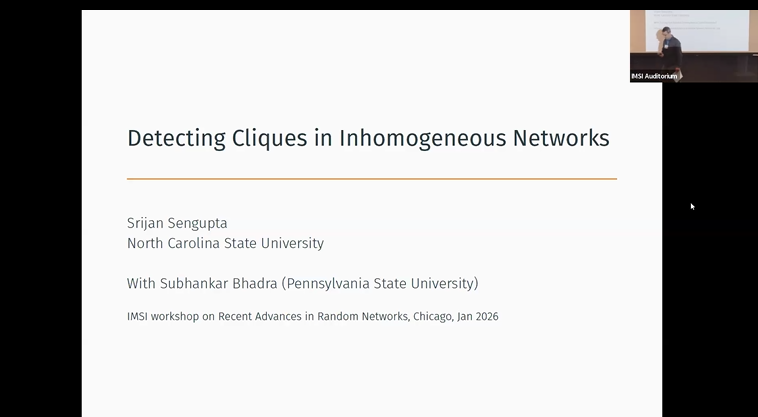
Finding Anomalous Cliques in Inhomogenous Networks using Egonets
Speaker: Srijan Sengupta (North Carolina State University)
We consider the problem of finding an anomalous clique, i.e., a fully connected subgraph, hidden in a large network. There are two parts to this problem: (1) detection, i.e., determining whether an anomalous clique is present, and (2) identification or localization, i.e., given that an anomalous clique is detected in part 1, determining which vertices of the network constitute the clique. This problem has a number of practical applications, such as financial trading networks, brain networks, and online social networks. A rich literature already exists on the detection problem when restricted to homogeneous Erd˝os–R´enyi random graphs. However, currently, no method exists that can solve the detection and identification/localization problems for inhomogeneous networks in finite time. We propose an inferential tool based on egonets to address this gap. The proposed method is computationally efficient and naturally amenable to parallel computing and easily extends to a wide variety of inhomogeneous network models. We establish the theoretical properties of the proposed method and demonstrate its empirical performance through simulation studies.
9:30-9:35 CST
Q&A
9:35-9:40 CST
Tech Break
9:40-10:10 CST
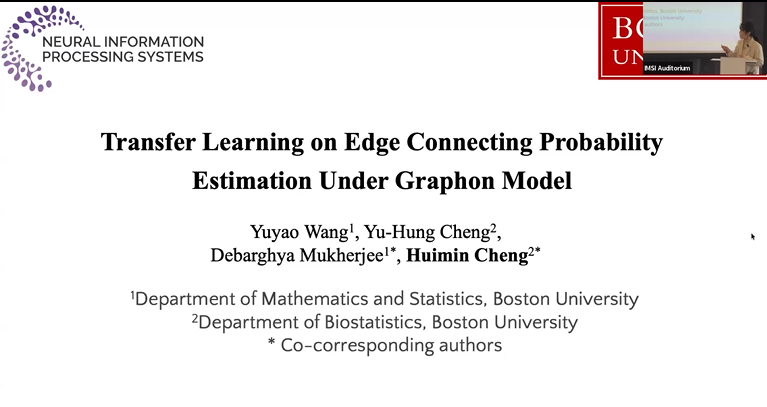
Transfer Learning on Edge Connecting Probability Estimation Under Graphon Model
Speaker: Huimin Cheng (Boston University)
Graphon models provide a flexible nonparametric framework for estimating latentconnectivity probabilities in networks, enabling a range of downstream applicationssuch as link prediction and data augmentation. However, accurate graphon estima-tion typically requires a large graph, whereas in practice, one often only observes asmall-sized network. One approach to addressing this issue is to adopt a transferlearning framework, which aims to improve estimation in a small target graph byleveraging structural information from a larger, related source graph. In this paper,we propose a novel method, namely GTRANS, a transfer learning framework thatintegrates neighborhood smoothing and Gromov-Wasserstein optimal transport toalign and transfer structural patterns between graphs. To prevent negative transfer,GTRANS includes an adaptive debiasing mechanism that identifies and corrects fortarget-specific deviations via residual smoothing. We provide theoretical guaranteeson the stability of the estimated alignment matrix and demonstrate the effectivenessof GTRANS in improving the accuracy of target graph estimation through extensivesynthetic and real data experiments. These improvements translate directly toenhanced performance in downstream applications, such as the graph classificationtask and the link prediction task.
10:10-10:15 CST
Q&A
10:15-10:45 CST
Coffee Break
10:45-11:15 CST
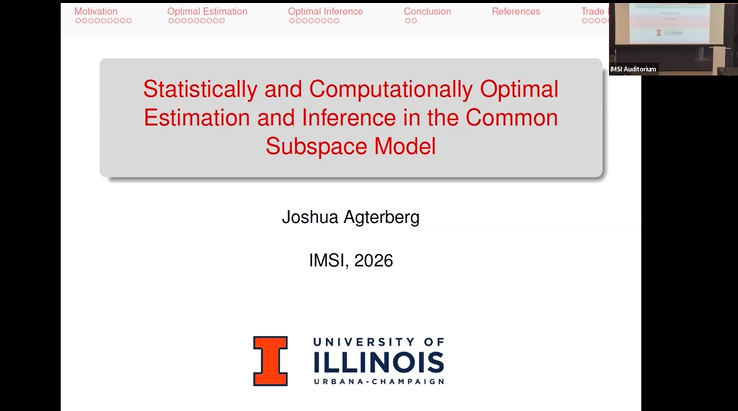
Statistically and Computationally Optimal Estimation and Inference in the Common Subspace Model
Speaker: Joshua Agterberg (University of Illinois at Urbana-Champaign)
11:15-11:20 CST
Q&A
11:20-11:25 CST
Tech Break
11:25-11:55 CST
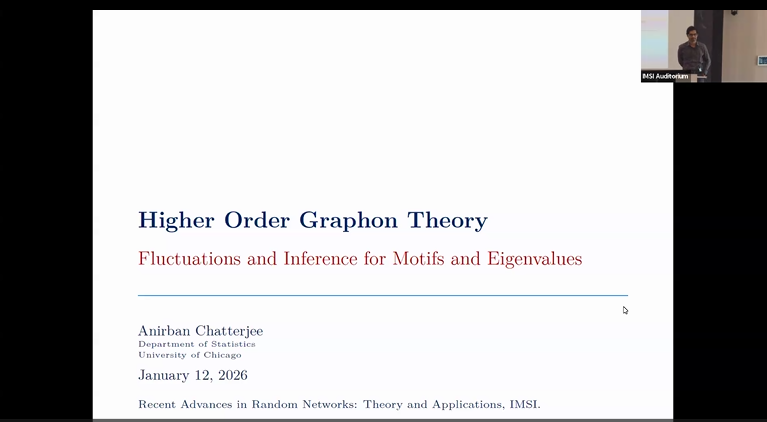
Higher Order Graphon Theory: Fluctuations, Degeneracies and Inference.
Speaker: Anirban Chatterjee (University of Chicago)
We study the asymptotic behavior of key network statistics in graphon-based random graphs, including subgraph counts and the largest eigenvalue. We show that both exhibit a fundamental dichotomy in their limiting distributions. Depending on the graphon, the limiting distribution may be Gaussian or have additional non-Gaussian components. For subgraph counts, we derive the joint asymptotic distributions and develop a multiplier bootstrap method for valid inference in both regimes. Using this bootstrap together with a procedure for detecting regimes, we construct joint confidence sets for any finite collection of motif densities, providing a general framework for inference based on network moments in the graphon model. For the largest eigenvalue, we establish analogous dichotomous behavior in the limiting distribution determined by the degree function of the graphon. These results uncover a unifying structure underlying fluctuations of combinatorial and spectral network statistics in graphon models.
11:55-12:00 CST
Q&A
12:00-13:00 CST
Lunch
13:00-13:45 CST
Working Group Preparation
13:45-15:00 CST
Working Groups
15:00-15:35 CST
Travel Time + Coffee Break
15:35-16:05 CST
Lightning Talks
16:05-16:30 CST
Poster Session + Social Hour
Tuesday, January 13, 2026
8:00-9:00 CST
Sign-in/Breakfast
9:00-9:30 CST
Recent Developments in Random Geometric Graphs and Their Applications
Speaker: Xiucai Ding (University of California, Davis (UC Davis))
In this talk, I will present recent developments on random geometric graphs (RGGs) where data are sampled from low-dimensional manifolds corrupted by noise, with motivations arising from manifold learning and spectral clustering. We establish the convergence of random geometric graphs to weighted Laplace–Beltrami operators and identify critical assumptions on the choice of radius. Building on these theoretical results, we provide practical guidance for constructing RGGs and explore their applications in manifold learning and spectral clustering, particularly when the data lie intrinsically on complex geometric structures such as manifolds.
9:30-9:35 CST
Q&A
9:35-9:40 CST
Tech Break
9:40-10:10 CST
Random geometric graphs with smooth kernels: sharp detection threshold and a spectral conjecture
Speaker: Jiaming Xu (Duke University)
We show that the critical dimension for distinguishing a random geometric graph with a smooth kernel from its Erdos–Renyi counterpart is given by $d_* = n^{3/4}$, much lower than $d_* = n^3$ for the hard RGG in [Bubeck-Ding-Eldan-Racz 2016]. To unify these results, we formulate a conjecture that the critical dimension is spectrally determined by $d = n^{3/4} b_1^{3/2}$, where $b_1/d$ is the second eigenvalue of the kernel operator.
10:10-10:15 CST
Q&A
10:15-10:45 CST
Coffee Break
10:45-11:15 CST
Optimal detection of planted matchings via the cluster expansion
Speaker: Cheng Mao (Georgia Institute of Technology)
We study the problem of detecting a planted matching — an independent edge set of order n — hidden in an Erdős–Rényi random graph G(n,p), formulated as a hypothesis testing problem. Unlike planted models with low-rank structures, the detection of a matching exhibits a smooth, not sharp, phase transition. More precisely, we show that the detection threshold occurs when p is on the order of n^(-1/2), at which the log-likelihood ratio is asymptotically normal. Moreover, the signed count of wedges (paths of length 2) is shown to be an asymptotically optimal statistic. Our main technique is the cluster expansion from statistical physics. In contrast to the widely used orthogonal expansion of the likelihood ratio, the cluster expansion is a series expansion of the log-likelihood ratio, which allows us to show its asymptotic normality directly.
11:15-11:20 CST
Q&A
11:20-11:25 CST
Tech Break
11:25-11:55 CST
The Topology of Network Change
Speaker: Patrick Rubin-Delanchy (University of Edinburgh)
Considering for example the challenges of cyber-security, misinformation and the pandemic, modelling large dynamic networks might be regarded as one of the defining statistical problems of the century. In particular, the scale, complexity and combinatorial nature of the data can make it hard to fit, or trust, parametric models.
In this talk, a notion of latent structure for a dynamic network is put forward, which is based on general underlying continuity assumptions rather than a specific parametric statistical model, and which can be estimated using a simple and novel statistical correlation coefficient.
The topology of this structure seems often to have a useful and intuitive interpretation. For example, seasonality manifests as a loop, and a continuous-time stochastic block model produces a filamentary structure in which branching points correspond to splitting and merging of communities. The proposed coefficient could provide a useful interactive tool to uncover such phenomena.
11:55-12:00 CST
Q&A
12:00-13:00 CST
Lunch
13:00-14:15 CST
Working Groups
14:15-14:45 CST
Travel Time + Coffee Break
14:45-15:30 CST
Panel: Career Deveopment and Perspectives
15:30-15:35 CST
Tech Break
15:35-16:20 CST
Panel: Network Analysis in the Era of Al
Wednesday, January 14, 2026
8:00-9:00 CST
Sign-in/Breakfast
9:00-9:30 CST
Comparing groups of networks
Speaker: Elizaveta Levina (University of Michigan)
Work on multiple networks has typically focused on estimating their shared structure. Two-sample tests for networks have also been developed, testing the hypothesis of two samples of networks coming from the same distribution. However, scientifically relevant hypotheses rarely take this form: for example, in neuroimaging, a common application for multiple network analysis where each network represents a patient’s brain connectome, it is rarely of interest to compare whole brains of patients and healthy controls; more often, the focus is on a particular brain region. Beyond comparisons, it is also of interest to estimate structures that are specific to a disease, or to some other trait in patients. One could always do that using just the patients with that trait, but using all available samples allows us to better estimate structures that are shared by all, which in turn helps separate out the structure associated with a trait. This talk will introduce two methods that help address these challenges: mesoscale testing on networks, which allows for formal hypothesis testing on a subset of edges (like a brain region) which leverages the rest of the network to increase power; and group MultiNeSS, a method that takes a sample of networks and estimates structures that are shared by all, specific to groups corresponding to a trait, or just unique to an individual. In both cases, we leverage the assumption of low-rank expectation of adjacency matrices which has been observed widely in practice. Based on joint work with Peter MacDonald, Alexander Kagan, and Ji Zhu.
9:30-9:35 CST
Q&A
9:35-9:40 CST
Tech Break
9:40-10:10 CST
Advances in dynamic and multiplex network modeling motivated by ecology
Speaker: David Dunson (Duke University)
Dynamic latent space models are widely used for characterizing changes in networks and relational data over time. These models assign to each node latent attributes that characterize connectivity with other nodes, with these latent attributes dynamically changing over time. Node attributes can be organized as a three-way tensor with modes corresponding to nodes, latent space dimension, and time. Unfortunately, as the number of nodes and time points increases, the number of elements of this tensor becomes enormous, leading to computational and statistical challenges, particularly when data are sparse. We propose a new approach for massively reducing dimensionality by expressing the latent node attribute tensor as low rank. This leads to an interesting new nested exemplar latent space model, which characterizes the node attribute tensor as dependent on low-dimensional exemplar traits for each node, weights for each latent space dimension, and exemplar curves characterizing time variation. We study properties of this framework, including expressivity, and develop efficient Bayesian inference algorithms. The approach leads to substantial advantages in simulations and applications to ecological networks.
10:10-10:15 CST
Q&A
10:15-10:45 CST
Coffee Break
10:45-11:15 CST
New approaches for estimating weak spikes
Speaker: Jiashun Jin (Carnegie Mellon University)
11:15-11:20 CST
Q&A
11:20-11:25 CST
Tech Break
11:25-11:55 CST
Non-robustness of diffusion estimates on networks with measurement error
Speaker: Tyler McCormick (University of Washington)
Network diffusion models are used to study things like disease transmission, information spread, and technology adoption. However, small amounts of mismeasurement are extremely likely in the networks constructed to operationalize these models. We show that estimates of diffusions are highly non-robust to this measurement error. First, we show that even when measurement error is vanishingly small, such that the share of missed links is close to zero, forecasts about the extent of diffusion will greatly underestimate the truth. Second, a small mismeasurement in the identity of the initial seed generates a large shift in the locations of expected diffusion path. We show that both results still hold when the vanishing measurement error is only local. Such non-robustness in forecasting exists even under conditions where the basic reproductive number is consistently estimable. Possible solutions, such as estimating the measurement error or implementing widespread detection efforts, still face difficulties because the number of missed links are so small. Finally, we conduct Monte Carlo simulations on simulated networks, and real networks from three settings: travel data from the COVID-19 pandemic in the western US, a mobile phone marketing campaign in rural India, and in an insurance experiment in China.
Minimax-Optimal Experimental Design for Network Interference on Pseudo-Random Graphs
Speaker: Shuangning Li (University of Chicago)
We study experimental design under network interference, a setting that arises in many applications such as medical and epidemiological interventions, political science field experiments, and online marketplace experiments. Under network interference, the outcome of a unit may depend on its own treatment and the treatments of its neighbors in a given interference graph. Our goal is to estimate the global average treatment effect, defined as the contrast between all units treated and all units in control. For any experimental design, understood as a joint distribution over treatment assignments, one can construct a Horvitz–Thompson estimator that directly incorporates the graph structure and is unbiased for the estimand. We consider the problem of choosing a design that minimizes the worst case variance of this estimator, where the worst case is taken over all potential outcome models with $ell_2$ norms bounded by $Csqrt{n}$. We first establish a lower bound: up to logarithmic factors, any design must incur worst case variance at least $Omega(d/n)$, where $d$ is the maximum degree of the interference graph. We then study a broad class of pseudo-random interference graphs, characterized by controlled codegree conditions, and show that this lower bound is tight. In particular, we construct a simple design that samples a random subset of nodes and assigns treatment to each selected node and its neighbors, and we show that its worst case variance is $O(d/n)$, again up to logarithmic factors. Together, the results show that for pseudo-random interference graphs the minimax rate for estimating the global average treatment effect is $Theta(d/n)$.
This is joint work with Shuangping Li from Yale University.
14:40-14:45 CST
Q&A
14:45-15:15 CST
Coffee Break
15:15-15:45 CST
Regression under network interference
Speaker: Michael Schweinberger (The Pennsylvania State University)
15:45-15:50 CST
Tech Break
15:50-16:30 CST
Panel: Real Data Challenges and Opportunities in Network Analysis
Thursday, January 15, 2026
8:00-9:00 CST
Sign-in/Breakfast
9:00-9:30 CST
Euclidean Mirrors and Changepoints in Network Time Series
We describe a model for a network time series whose evolution is governed by an underlying stochastic process, known as the latent position process, in which network evolution can be represented in Euclidean space by a curve, called the Euclidean mirror. We define the notion of a first-order changepoint for a time series of networks, and construct a family of latent position process networks with first-order changepoints. We show how a spectral estimate of the associated Euclidean mirror can localize these changepoints and provide simulated and real data examples of such localization.
9:30-9:35 CST
Q&A
9:35-9:40 CST
Tech Break
9:40-10:10 CST
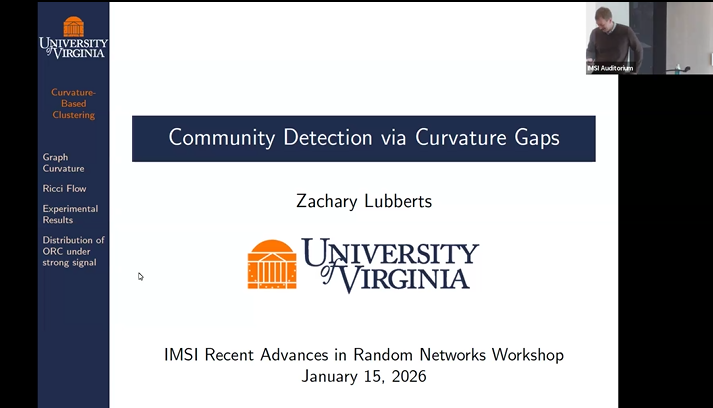
Curvature-Based Clustering on Graphs
Speaker: Zachary Lubberts (University of Virginia)
Unsupervised node clustering (or community detection) is a classical graph learning task. In this work, we study algorithms that exploit the local geometry of the graph to identify densely connected substructures, which form clusters or communities. Our method implements discrete Ricci curvatures and their associated geometric flows, under which the edge weights of the graph evolve to reveal its community structure. We consider several discrete curvature notions and analyze the utility of the resulting algorithms. In contrast to prior literature, we study not only single-membership community detection, where each node belongs to exactly one community, but also mixed-membership community detection, where communities may overlap. For the latter, we argue that it is beneficial to perform community detection on the line graph. We provide both theoretical and empirical evidence for the utility of our curvature-based clustering algorithms. In addition, we give several results on the relationship between the curvature of a graph and its line graph, which enable the efficient implementation of our proposed mixed-membership community detection approach and which may be of independent interest for curvature-based network analysis.
10:10-10:15 CST
Q&A
10:15-10:45 CST
Coffee Break
10:45-11:15 CST
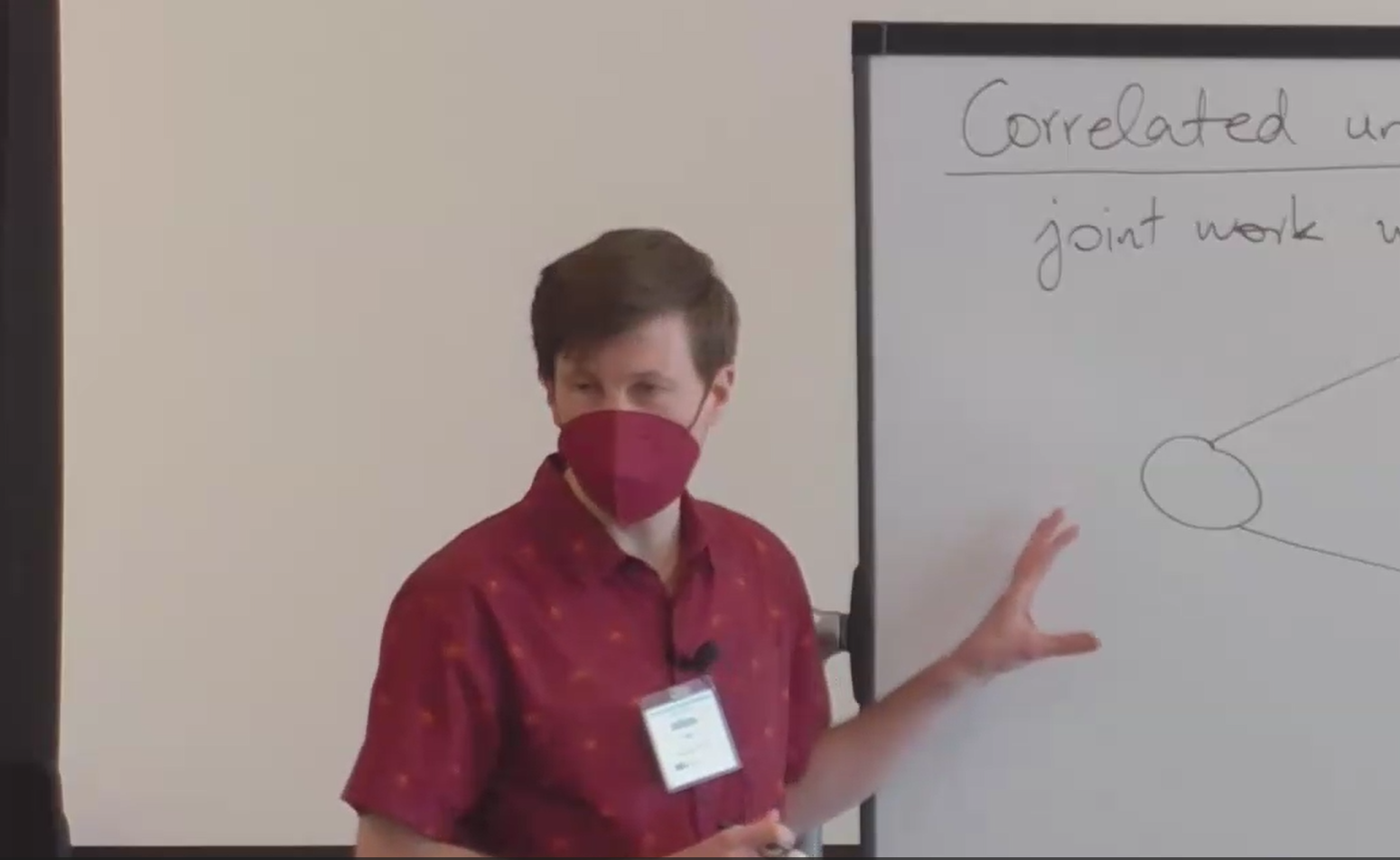
Correlated uniform attachment trees
Speaker: Miklos Racz (Northwestern University)
I will introduce a new model of correlated uniform attachment trees, where correlation is sprinkled throughout the time evolution of the process. I will discuss results about natural detection and estimation questions. The proofs rely on constructing statistics of a multi-scale nature that find early vertices using a centrality measure and compute certain quantities related to degrees. Along the way, we prove a new result about finding early vertices which may be of independent interest in network archaeology. This is based on joint work with Johannes Bäumler, Nathan Ross, and Anirudh Sridhar.
11:15-11:20 CST
Q&A
11:20-11:25 CST
Tech Break
11:25-11:55 CST
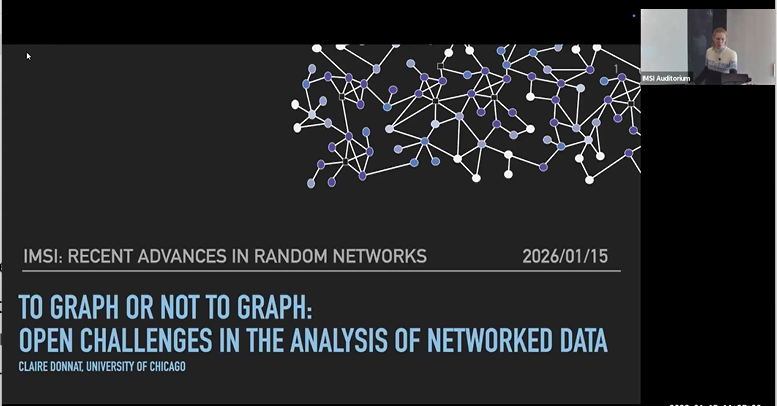
“To Graph or not to graph”
Speaker: Claire Donnat (University of Chicago)
11:55-12:00 CST
Q&A
12:00-13:00 CST
Lunch
13:00-14:00 CST
Working Group
14:00-14:10 CST
Travel Time
14:10-14:40 CST
Some aspects of dynamic networks: Privacy and non-stationarity
Speaker: Yi Yu (University of Warwick)
14:40-14:45 CST
Q&A
14:45-15:15 CST
Coffee Break
15:15-15:45 CST
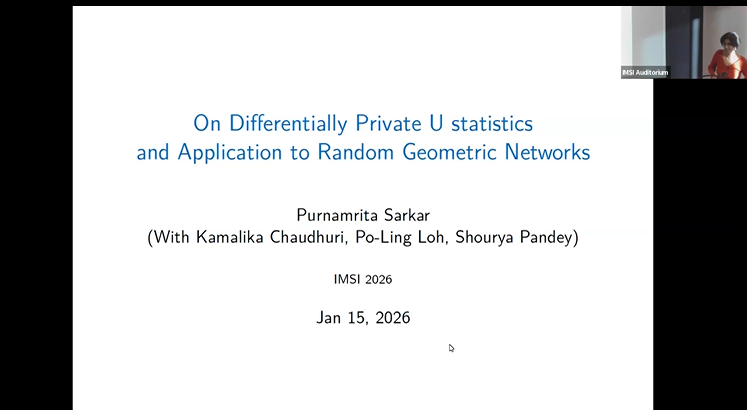
On differential privacy of U statistics and applications to random networks
Speaker: Purna Sarkar (University of Texas, Austin)
We consider the problem of privately estimating a parameter 𝔼[h(X1,…,Xk)], where X1, X2, …, Xk are i.i.d. data from some distribution and h is a permutation-invariant function. Without privacy constraints, standard estimators are U-statistics, which commonly arise in a wide range of problems, including subgraph counts in random networks, nonparametric signed rank tests, symmetry testing, uniformity testing, and can be shown to be minimum variance unbiased estimators under mild conditions. Despite the recent surge in interest in private mean estimation, the privatizing of U-statistics has received relatively little attention. While existing private mean estimation algorithms can be applied to obtain confidence intervals, we show that they can lead to suboptimal private error, e.g., constant-factor inflation in the leading term, or even Θ(1/n) rather than O(1/n^2) in degenerate settings. To remedy this, we propose a new thresholding-based approach using local Hájek projections to reweight different subsets of the data. This leads to nearly optimal private error for non-degenerate U-statistics and a strong indication of near-optimality for degenerate U-statistics.
15:45-15:50 CST
Tech Break
15:50-16:30 CST
Panel: The Future of Network Analysis
Friday, January 16, 2026
8:00-9:00 CST
Sign-in/Breakfast
9:00-10:30 CST
Workshop Groups report-out Part 1
10:30-11:00 CST
Coffee Break
11:00-12:30 CST
Working Groups report-out Part 2
12:30-12:45 CST
Workshop Survey and Close
Videos
Finding Anomalous Cliques in Inhomogenous Networks using Egonets
Srijan Sengupta January 12, 2026
Transfer Learning on Edge Connecting Probability Estimation Under Graphon Model
Huimin Cheng January 12, 2026
Statistically and Computationally Optimal Estimation and Inference in the Common Subspace Model
Joshua Agterberg January 12, 2026
Higher Order Graphon Theory: Fluctuations, Degeneracies and Inference.
Anirban Chatterjee January 12, 2026
Lightning Talks
Lightning Talks January 12, 2026
Recent Developments in Random Geometric Graphs and Their Applications
Xiucai Ding January 13, 2026
Random geometric graphs with smooth kernels: sharp detection threshold and a spectral conjecture
Jiaming Xu January 13, 2026
Optimal detection of planted matchings via the cluster expansion
Cheng Mao January 13, 2026
Advances in dynamic and multiplex network modeling motivated by ecology
David Dunson January 14, 2026
Non-robustness of diffusion estimates on networks with measurement error
Tyler McCormick January 14, 2026
Minimax-Optimal Experimental Design for Network Interference on Pseudo-Random Graphs
Shuangning Li January 14, 2026
Regression under network interference
Michael Schweinberger January 14, 2026
Curvature-Based Clustering on Graphs
Zachary Lubberts January 15, 2026
Correlated uniform attachment trees
Miklos Racz January 15, 2026
“To Graph or not to graph”
Claire Donnat January 15, 2026
Some aspects of dynamic networks: Privacy and non-stationarity
Yi Yu January 15, 2026
On differential privacy of U statistics and applications to random networks